
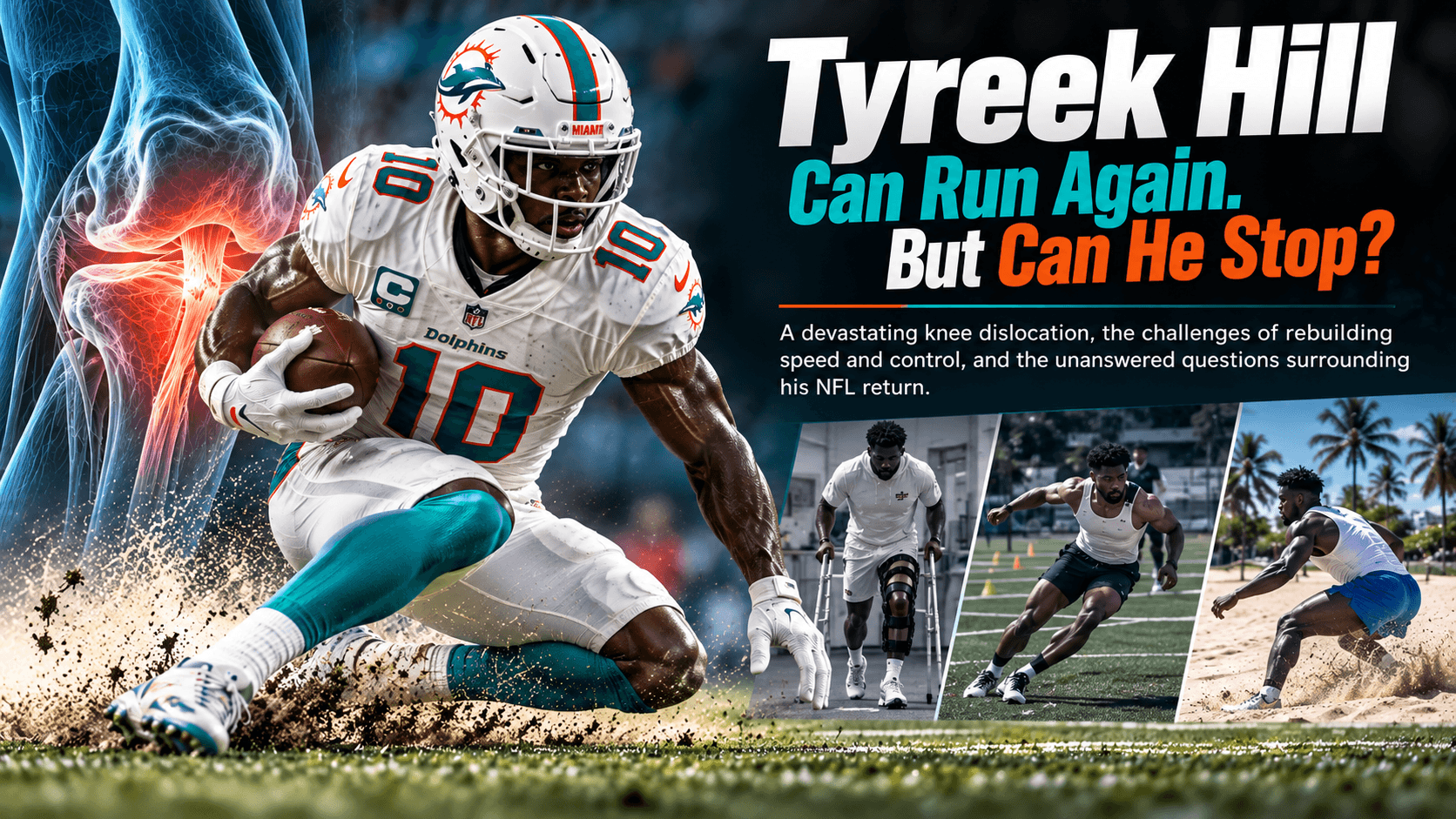
Tyreek Hill Can Run Again. But Can He Stop?
A devastating knee dislocation, the challenges of rebuilding speed and control, and the unanswered questions surrounding his NFL return.
Tyreek Hill is running again.
Just over a year after suffering a devastating left knee dislocation, the former Miami Dolphins receiver is posting videos of himself sprinting, changing direction and working through agility drills.
For a player whose career has been built around extraordinary speed, these are encouraging developments.
But watching his latest rehabilitation footage, I find myself asking a different question.
Can his braking system handle the horsepower he's beginning to generate?
In July, Hill openly acknowledged struggling to regain power in his injured left leg. More recent videos suggest meaningful progress, but there are moments during deceleration where his left leg appears noticeably stiffer than his right.
That observation becomes particularly interesting when we revisit the original injury and the possibility of neurological involvement.
This was not a routine ACL tear.
And returning from it may involve far more than rebuilding strength.
September 29, 2025: More Than a Torn ACL
Hill was tackled near the sideline during Miami's game against the New York Jets. As Jets defensive back Malachi Moore brought him down, Hill's left leg became trapped beneath him.
The resulting forces caused a traumatic dislocation of his left knee, with reported damage involving the ACL and additional ligamentous structures. Hill subsequently reported undergoing another procedure involving his lateral collateral ligament (LCL).
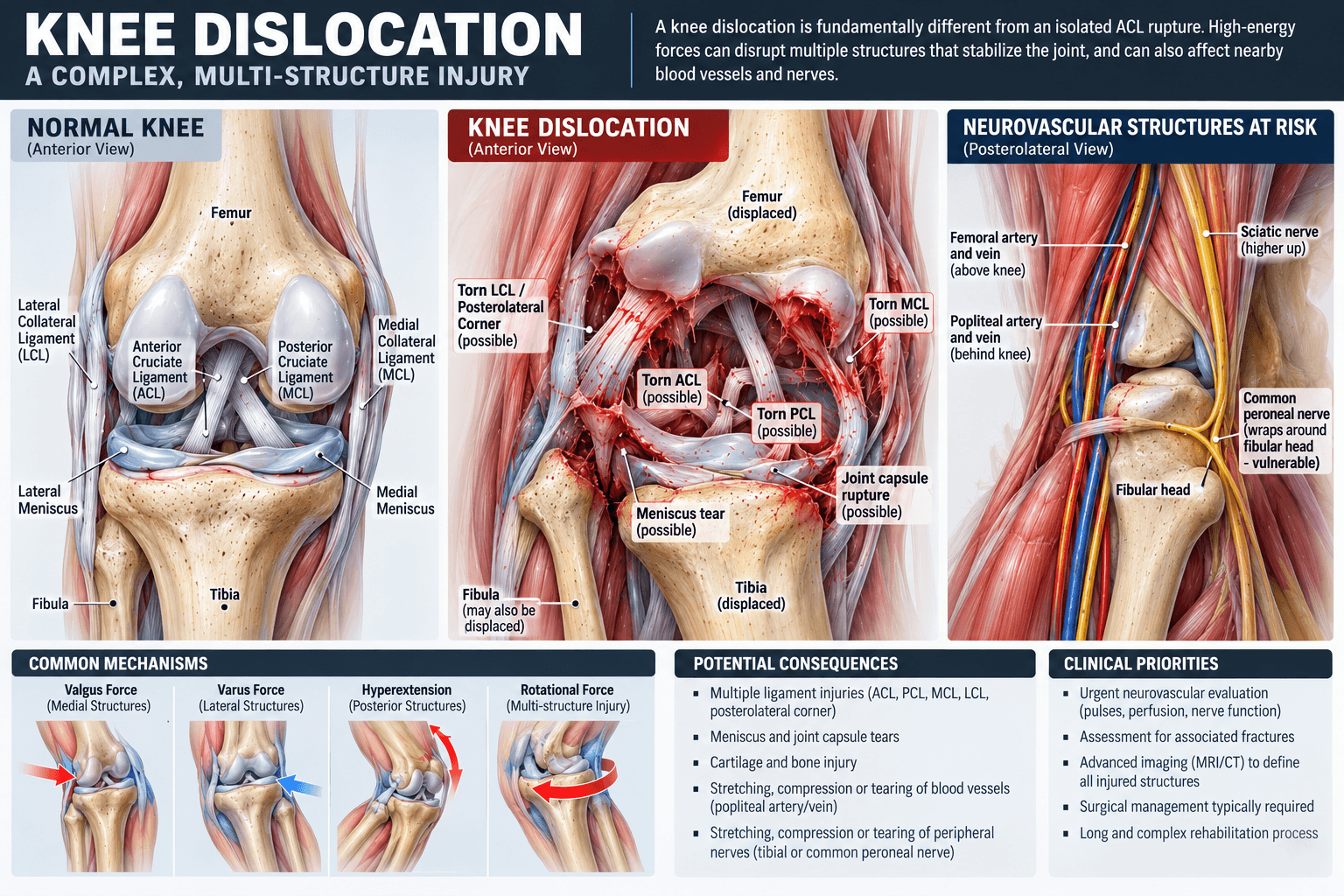
A knee dislocation is fundamentally different from an isolated ACL rupture.
Multiple structures responsible for stabilizing the joint can be disrupted simultaneously. Depending on the direction and magnitude of the forces, injuries may involve the ACL, PCL, collateral ligaments, posterolateral corner, joint capsule and surrounding soft tissues.
The consequences can extend beyond the ligaments themselves.
Major blood vessels and peripheral nerves pass immediately behind and around the knee. They can be stretched, compressed or torn during a dislocation.
This is why knee dislocations require urgent neurovascular evaluation.
Hill underwent surgery the following day. His subsequent recovery has involved two reported procedures.
But footage released shortly after his first surgery raised another important question.
The Early Walking Video: Was There a Nerve Injury?
On October 2, 2025, Hill appeared in a video taking his first assisted steps after surgery.
He was walking with a frame and wearing a protective knee brace.
It was an encouraging milestone, but the movement of his left foot raises an interesting question about possible neurological involvement.
Hill Walking with Assistance, October 2, 2025
One potential concern following a traumatic knee dislocation is injury to the common peroneal nerve.
The common peroneal nerve travels around the outside of the knee near the fibular neck. Its location makes it particularly vulnerable during traumatic knee dislocations.
The nerve contributes to the muscles responsible for lifting the foot and toes, as well as turning the foot outward.
When injured, patients may struggle to dorsiflex the ankle, creating what is commonly called foot drop.
Rather than clearing the ground normally during walking, the foot may drag or require compensatory movement at the hip and knee.
Importantly, foot drop has not been publicly confirmed as a diagnosis in Hill's case.
Early postoperative walking is also influenced by bracing, pain, swelling, surgical restrictions and the use of walking aids. Those factors limit what can be concluded from the video.
Nevertheless, given the original trauma, the possibility of neurological involvement deserves attention.
Research has reported common peroneal nerve involvement in approximately 5% to 40% of traumatic knee dislocations, with substantial differences depending on injury severity and study population.
The prognosis depends heavily on whether the nerve injury is partial or complete.
This distinction could have enormous implications for a player whose position demands precise control of the foot and ankle at extraordinary speeds.
July 2026: The Power Problem
Approximately 10 months after his injury, Hill released rehabilitation footage that included running, jumping and pool exercises.
He was remarkably candid about the challenges he was experiencing.
He described having essentially no power in his left leg and working to rebuild it.
Those comments are important.
Power generation following a major knee injury is not simply a question of rebuilding muscle mass.
An athlete needs to restore force production, rate of force development, coordination between muscle groups and the ability to recruit those muscles under increasingly demanding conditions.
Following multiligament reconstruction, deficits in quadriceps function and neuromuscular control can persist long after an athlete resumes running.
But power production is only half the equation.
October 2026: What About the Braking System?
More recent footage shows Hill sprinting on turf. Other rehabilitation footage shows him performing change-of-direction exercises on sand.
At first glance, the progress is impressive.
But in the turf video, particularly during his first two deceleration steps, his left leg appears relatively stiff compared with his right.
There seems to be less knee flexion and potentially a different strategy for accepting load.
October turf sprint and deceleration footage
One possible explanation is reduced eccentric strength.
Eccentric muscle action allows the body to absorb energy as muscles lengthen under tension. During deceleration, the quadriceps, hip extensors, calf musculature and other structures work together to manage substantial braking forces.
An athlete who struggles to control these forces may adopt a more rigid movement strategy.
Instead of allowing the joints to flex and the muscles to absorb load through a larger range, the athlete may increase joint stiffness to create a feeling of stability.
This can be a protective adaptation.
However, it is important to recognize that the footage is limited. Camera angle, speed, step sequence and the specific task all influence how the movement appears.
We cannot establish an eccentric strength deficit from a few video frames.
What we can do is identify questions worth investigating.
The Beach Footage: Another Piece of the Puzzle
In September, Hill also shared footage of agility and change-of-direction work on sand.
Again, the athleticism is encouraging.
But certain positions raise similar questions about how he manages load through the left leg.
During some directional changes, he appears to rely on relatively rigid lower-extremity positioning and substantial trunk movement.
These movements may be perfectly appropriate for the task, particularly given the unstable sand surface.
Nevertheless, viewed alongside the turf footage, they raise an interesting question.
Is Hill consistently using a protective strategy to manage braking forces through his reconstructed left knee?
That is where I would focus my attention.
Could Neurological Involvement Explain Some of the Stiffness?
This may be the most important unanswered question.
If Hill experienced a common peroneal nerve injury, we need to know whether it recovered completely.
The peroneal nerve does not directly control the quadriceps, so an isolated peroneal nerve injury would not automatically explain reduced knee flexion or eccentric quadriceps weakness.
However, persistent weakness in ankle dorsiflexion or eversion, impaired sensation, or altered proprioceptive feedback could affect how an athlete positions the foot, controls the ankle and organizes movement during high-speed tasks.
Those changes could influence loading farther up the kinetic chain.
A player might compensate through increased knee or hip stiffness, altered foot placement or a different braking strategy.
That does not establish a direct connection between the early suspected foot drop and the stiffness observed in October.
But it is a reasonable hypothesis to investigate.
And the distinction matters.
Dysfunction or Lasting Impairment?
If the primary limitation is muscular weakness or a learned protective movement strategy, there may be considerable opportunity to improve it through targeted reconditioning.
If there is persistent peripheral nerve damage, some limitations may be more resistant to rehabilitation.
Even then, neurological impairment does not automatically mean permanent disability. Nerve recovery exists on a spectrum, and the functional consequences depend on the specific structures involved and the extent of recovery.
The challenge is determining what can still be restored, what must be accommodated and whether the athlete can safely tolerate the demands of competition.
A professional team considering Hill should understand that distinction before making assumptions based on his sprinting videos.
What Does This Mean for an NFL Wide Receiver?
Hill's game has never been based on speed alone.
His ability to accelerate, decelerate, change direction and create separation has made him one of the NFL's most dangerous receivers.
At the professional level, a receiver must repeatedly:
- Accelerate explosively from different starting positions.
- Decelerate within a few steps to execute routes.
- Plant and redirect against defensive coverage.
- React to unexpected movements from defenders.
- Adjust to imperfect throws while maintaining balance.
- Absorb contact in unpredictable positions.
Running fast in a controlled environment is encouraging.
But it does not replicate those demands.
If Hill has persistent limitations in braking or directional control, an offensive coordinator might initially emphasize routes that take advantage of his linear acceleration and speed while limiting repeated, aggressive changes of direction.
Vertical routes, certain crossing concepts and opportunities to build speed in space could be useful examples.
But that would be a tactical accommodation, not evidence that the underlying problem has been resolved.
And even a straight-line route can require sudden braking, unplanned cutting or contact.
No route design can eliminate those demands completely.
The Psychological and Personal Demands of Returning
There is another side of Hill's recovery that deserves consideration.
A traumatic injury of this magnitude can challenge an athlete's confidence, identity and sense of physical security.
For a player whose success has depended on exceptional speed, losing the ability to produce power through one leg can be especially difficult.
Returning from a serious injury involves more than restoring tissue integrity. Athletes must also regain confidence in their bodies and the ability to respond instinctively under pressure.
Hill has also been dealing with highly publicized legal proceedings involving his estranged wife.
On October 13, 2026, a civil jury reportedly found Hill liable for two battery claims and awarded his estranged wife $500,000 in compensatory damages. The jury reportedly found him not liable on eight other claims.
These proceedings are separate from his injury, and we cannot assume how they have affected his psychological health or rehabilitation.
Nevertheless, comprehensive athlete care should account for the wider personal and professional demands surrounding a return to competition.
Sleep, stress, emotional readiness, recovery resources and social support can all influence the rehabilitation experience.
The goal should be to understand the whole person without using personal circumstances to speculate about the cause of a physical impairment.
What Would I Want to Know Before Signing Tyreek Hill?
If I were involved in evaluating Hill's return, the questions would extend well beyond whether he can reach his previous top speed.
First, I would want to understand the full extent of the original ligament and neurological injuries.
Was there confirmed common peroneal nerve damage? If so, was it partial or complete? What has recovered, and are there any persistent motor or sensory deficits?
Second, I would examine his ability to produce and absorb force.
That would include objective assessment of quadriceps and hamstring strength, eccentric capacity, reactive strength, limb-specific loading and repeated deceleration performance.
Third, I would assess how those capacities translate into football.
Can he decelerate and cut in both directions? Can he maintain control when reacting to an unpredictable stimulus? What happens when fatigue increases?
And perhaps most importantly, can he execute those tasks without consistently relying on compensatory movement strategies?
These questions are not intended to undermine the work Hill or his rehabilitation team has accomplished.
His progress following such a devastating injury is significant.
But medical clearance, the ability to run and readiness to tolerate the demands of an NFL game are not interchangeable.
Final Thoughts: The Brakes Must Handle the Horsepower
Tyreek Hill's return would be an extraordinary athletic achievement.
He has already demonstrated considerable progress from an injury that threatened far more than his football career.
But the footage raises questions that deserve closer examination.
The early concern about possible foot drop, his July comments about reduced left-leg power and the more recent appearance of stiffness during deceleration are three observations from different stages of recovery.
They may be related. They may not.
Without access to his neurological examinations, strength testing, surgical details and movement assessments, we cannot know.
What we should recognize is that restoring speed does not necessarily mean restoring the ability to control it.
And if some limitations reflect lasting neurological impairment rather than a modifiable movement dysfunction, that distinction becomes critical for both the athlete and the team considering signing him.
The objective should not simply be to get Tyreek Hill running fast again.
It should be to understand what his body can safely and consistently tolerate, and then build his return around those capabilities.
Because no matter how much horsepower an athlete generates, the brakes still need to handle it.


